
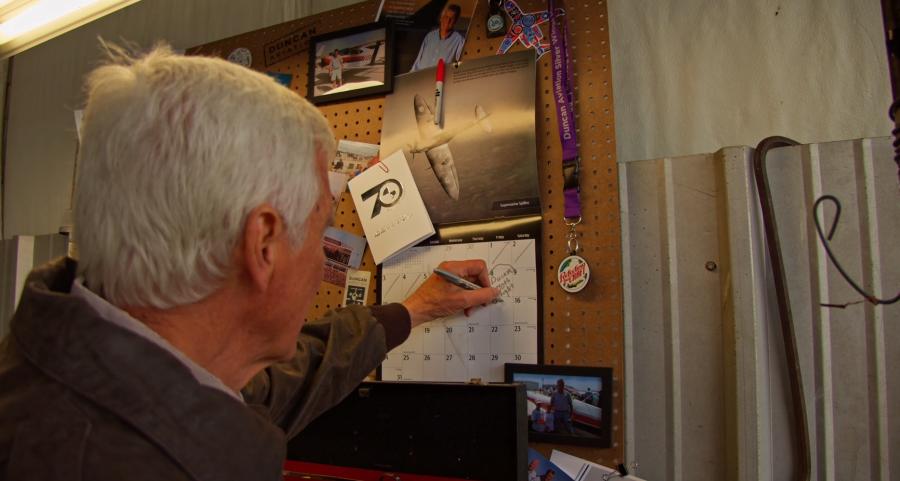
 For 70 years, Duncan Aviation has left its mark on business aviation. To celebrate the milestone, longtime team member Doug Roth found a way to make that mark visible from the sky. Click image for high-res download.
LINCOLN, NEB. — For 70 years, Duncan Aviation has left its mark on business aviation. To celebrate the milestone, longtime team member Doug Roth found a way to make that mark visible from the sky.
Roth, an Aircraft Sales & Acquisitions Representative who has spent 43 years with Duncan Aviation, recently climbed into his Sorrell SNS-7 Hiperbipe and flew a route over Lincoln, Nebraska, that traced the outline of Duncan Aviation’s 70th anniversary logo. When viewed on FlightAware, the flight path revealed a carefully drawn “70” — a tribute to the company’s history, its people, and the passion for aviation that has shaped both Roth’s career and Duncan Aviation’s legacy.
Duncan Aviation is celebrating its 70th anniversary in 2026 under the banner “The Passion for Aviation. The Heart of a Family.”
“For 70 years, we’ve left our mark on aviation,” Roth said. “Today, we left it on the sky.”
See the flight come to life in this feature film.
The flight was a creative celebration of Duncan Aviation’s milestone year, but the idea began much more casually. After an instrument recurrency flight, Roth mentioned to team member Rebekah Williams, Aircraft Sales & Acquisitions Market Research Team Leader, that she could look up his route on FlightAware and see his flight path around the Lincoln airport. She joked that he should use the airplane to write her name sometime. Roth tucked the idea away.
Later, he tried it. First, he wrote “Hi Chris” for his wife, Chris. Then he planned and flew another route that spelled “Hi Bekah” for Rebekah. The successful skywriting-by-flight-track sparked a bigger idea: If Roth could write names in the sky, could he fly Duncan Aviation’s 70th anniversary logo?
From there, the project quickly grew from a fun idea into a detailed flight-planning challenge. Roth and the marketing team first had to decide what the flight path should look like. Because the full logo includes interior details that would be difficult to recreate cleanly in the air, they chose to focus on the exterior outline of the “70.” That decision gave Roth a clear target: create a route that would be recognizable, accurate, and flyable.
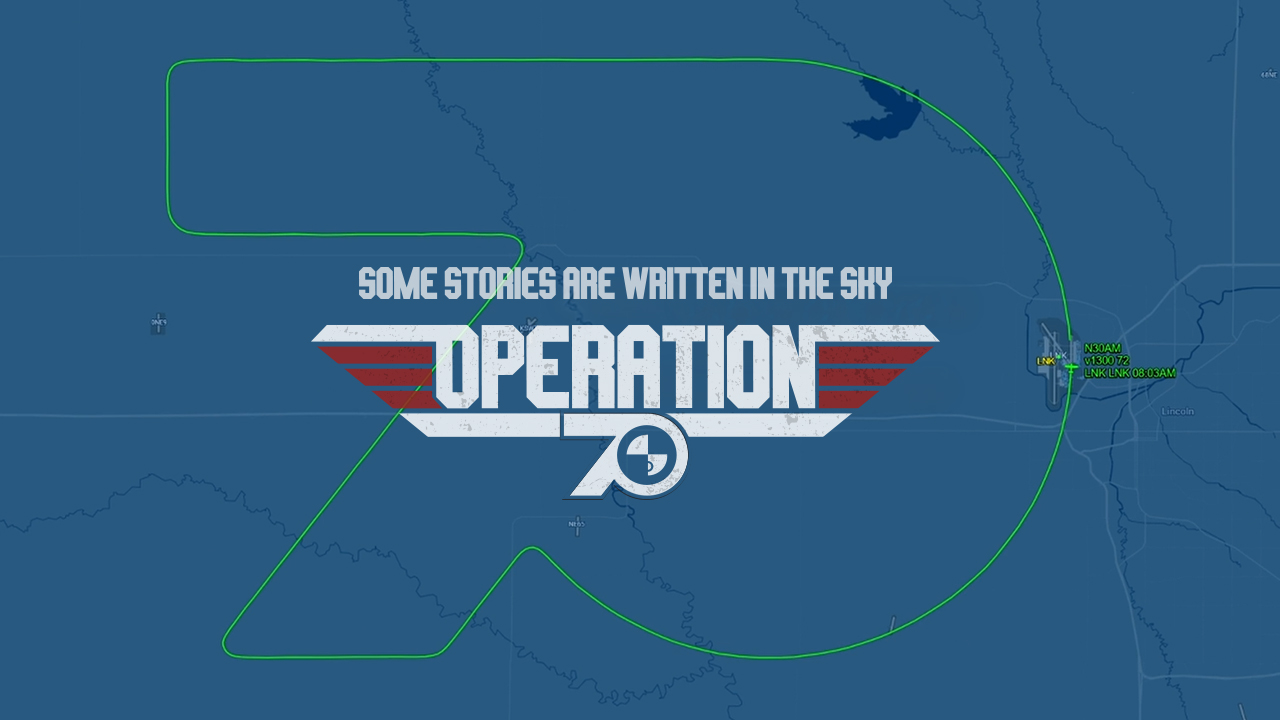
Roth used Google Earth to build the shape, starting with the most difficult element: the zero. By creating a circle over the Lincoln Airport area, adjusting its size, and then measuring the remaining points of the logo proportionally, Roth developed a series of waypoints that could become a flight plan.
He exported those points, converted them into a spreadsheet, adjusted the shape, reloaded it into Google Earth to check the appearance, and repeated the process until the logo looked right. Once the digital route was ready, he converted it into a file for his Garmin GPS 175 and loaded it into the aircraft.
Flying the line required another layer of precision. Roth found that simply following the HSI needle would not be accurate enough; even if the needle stayed centered, the final FlightAware track could appear wavy. Instead, he zoomed the GPS map all the way in to its highest resolution, using the on-screen course line and airplane position to keep the flight path as clean as possible.
The corners brought another challenge. Roth originally considered using aerobatic hammerhead turns to create sharp points, but part of the route was near Federal Airways, making aerobatic turns inappropriate. Instead, he slowed the airplane for the corners, tightening the turn radius while maintaining enough speed for safe controllability.
During the flight, Roth climbed as high as 4,500 feet before descending to about 3,500 feet. He flew much of the route near the Hiperbipe’s cruise speed of about 135 knots and slowed to roughly 80 knots for the tighter turns.
He also coordinated ahead of time with the Lincoln Airport tower, sharing an image of the intended route and asking whether they could accommodate the unconventional flight path early in the morning when traffic was light. They agreed and coordinated with approach control.
With the route built, the GPS loaded, the tower briefed, and the airplane ready, Roth took off.
Although Roth had completed a couple of partial practice flights to work on the lower portion of the seven and the transition into the zero, the full outline of the logo came together on his first complete attempt.
“I was very happy,” Roth said. “The more I looked at it, the happier I was.”
The airplane Roth used for the tribute has been part of his story for decades. His Hiperbipe is an experimental homebuilt aerobatic biplane, a kit aircraft design introduced in the 1970s. The Sorrell SNS-7 Hiperbipe is known as a two-seat, cabin-style aerobatic biplane designed for amateur construction. Roth bought his in 1988 with just 52 hours on it.
Today, after rebuilding it, repainting it, flying aerobatics, giving rides, and performing in air shows, the aircraft has nearly 990 hours.
When Roth first bought the airplane, he mainly wanted to have fun, fly simple competition aerobatics, and give people rides. Over time, encouragement from the late Duncan Aviation legend and pilot Harry Barr helped him take the airplane further than he expected.
“He was always encouraging me to try something new,” Roth said. “Essentially, it was his encouragement that took me to the higher level to where I am today.”
Those higher levels included advanced aerobatic competition and many air show performances. Roth first got into air shows through Duncan Aviation events, then continued after Barr invited him to fly another show in Wahoo, Nebraska, the very next day. What began as a one-time opportunity grew into a long-running part of his aviation life.
Still, some of Roth’s favorite memories in the airplane are quieter ones: giving rides to people who are experiencing aerobatics for the first time, especially younger passengers. He enjoys showing them that aerobatics can be gentle, controlled, and fun.
“It gives them another look at it,” he said. “Just the wow factor, the amazement that they come away with — it reignites their enthusiasm into the basics of flying.”
That love of flying goes back to childhood. Roth’s father learned to fly when Roth was in first grade, and some of his earliest memories include flying with him. His father and uncle often talked about airplanes, and Roth grew up building model aircraft and dreaming about flying himself.
He began flight training in February 1975 and earned his private pilot certificate that June. Today, he has over 7,200 flight hours.
His aviation career started in electronics. After high school, Roth earned a second-class FCC license and went to work in the radio shop for Lincoln Avionics at the airport. It combined two interests that came naturally to him: electronics and airplanes. Eventually, he joined Duncan Aviation in 1983, entering aircraft sales at a time when the company was still heavily known for aircraft sales and was just beginning its major growth as a maintenance, repair, and overhaul organization.
Over the past 43 years, Roth has watched Duncan Aviation evolve from a company of a few hundred people into a global business aviation service provider. He remembers when there were no satellite shops, no large network of traveling sales representatives, and when everyone on the Lincoln ramp seemed to know everyone else. He also remembers the early growth of AVPAC and the first satellite avionics shop in Houston.
For Roth, that growth has been exciting to witness, especially from the perspective of aircraft sales. As Duncan Aviation expanded into new technologies, larger aircraft, avionics, interiors, paint, and maintenance capabilities, Roth’s own career grew with it.
“It was the best decision I ever made,” he said of joining Duncan Aviation.
When asked why he volunteered his time, airplane, fuel, and planning effort for the 70th anniversary flight, Roth’s answer was simple.
“It’s something I can give back to the company,” he said. “Working for Duncan Aviation has been a great career and it’s been a great company to work for. The company does a lot for us employees.”
That gratitude fits naturally with the company’s 70th anniversary theme: The Passion for Aviation. The Heart of a Family. Roth sees both ideas reflected in Duncan Aviation’s history, beginning with founder Donald Duncan’s love of flying and continuing through the Duncan family’s ongoing commitment to aviation, employees, customers, and quality work.
For Roth, aviation has always offered a combination of challenge, skill, freedom, and peace. Whether he is flying aerobatics, making a landing as smooth as possible, cruising across the prairie, or carefully tracing a company logo in the sky, the feeling remains the same.
“When I’m flying, there’s nothing that beats the freedom and openness of being in the air,” Roth said.
And for one anniversary flight, that openness became a canvas — one drawn with waypoints, a Hiperbipe, decades of flying experience, and a deep appreciation for the company Roth has called home for 43 years.
Duncan Aviation is an aircraft service provider supporting the aviation needs of business aircraft operators, government agencies, and other aircraft service providers. Services include major and minor airframe inspections, engine maintenance, major retrofits for cabin and cockpit avionics systems, full paint and interior services, engineering and certification services, fabrication and manufacturing services, and preowned aircraft sales and acquisitions. Duncan Aviation also has international aircraft components solutions experts available 24/7/365 at +1 402.475.4125 who can handle any aircraft system problem with immediate exchanges, rotables, loaners or avionics/instrument/accessory repairs and overhauls. Complete service facilities are located in Battle Creek, Michigan; Lincoln, Nebraska; and Provo, Utah. We also have dozens of other facilities strategically located throughout the United States to provide customers with scheduled regional support and the quickest response possible to avionics, engine and airframe Aircraft On Ground (AOG) situations.
For more information about any of Duncan Aviation’s services, call +1 402.475.2611 or visit https://DuncanAviation.aero/services
Duncan Aviation Adds Global Nose Landing Gear Rental Option for AOG Support
October 06, 2026
Duncan Aviation Invites NBAA-BACE Attendees to Participate in 70th Anniversary Celebration
September 28, 2026
Duncan Aviation's Joe Tulowitzki Receives Charles Taylor Master Mechanic Award
September 28, 2026
Duncan Aviation Appoints Sasha Orth as Landing Gear Sales Representative
September 16, 2026
Duncan Aviation Installs and Rigorously Tests Gogo 5G On Its Own Citation Excel
August 20, 2026